"It was foul, and I loved it. I loved my own undoing."
— Saint Augustine, Confessions — reflecting on his youth in Numidia
A Roman City of Scholars
Madauros was one of the great cities of Roman Numidia — a prosperous inland colony famous above all for its schools. Founded as a Numidian settlement with Berber-Punic roots, it passed through the rule of King Syphax and then Masinissa before Roman incorporation after 146 BC. Under Roman authority it became Colonia Flavia Augusta Veteranorum Madaurensium, a colony settled by Roman veterans and elevated to a center of Latin civic culture, olive production, and higher learning.
Its reputation for education is what placed Madauros in history. When Augustine's father Patricius scraped together the money to give his brilliant son a proper Roman education, it was to Madauros he sent him — the closest city of serious schools to their home in Thagaste.
Augustine's Years in Madauros
Around 360 AD, a twelve-year-old Augustine arrived in Madauros to study grammar and rhetoric. He was roughly 24 kilometres from home — far enough to be formative, close enough to return. The city's schools offered the classical Roman curriculum: Latin poetry, grammar, rhetoric, and the foundations of literary culture that would one day make the Confessions and The City of God possible.
These years were among the most intellectually decisive of Augustine's early life. He threw himself into Roman literature and pagan learning with an intensity that both thrilled and troubled him in retrospect. His later letters show continuing ties to the people of Madauros long after his conversion — the city never fully left him.
For pilgrims following the Via Augustina, Madauros is the second station: the place where the boy from Thagaste first encountered the wider Roman world, and where the scholar who would shape Western Christianity was first formed.
Birthplace of Apuleius
Two centuries before Augustine walked its streets, Madauros gave the world another giant of Latin literature. Apuleius was born here around 123–124 AD and grew up to write The Golden Ass — the only Latin novel to survive complete from antiquity, and one of the strangest and most captivating works in all of Roman literature.
Apuleius was a Platonic philosopher, rhetorician, and master of prose style. His presence makes Madauros unique in the ancient world: it is the only city that can claim to have produced both a foundational Latin novelist and a foundational Christian theologian — separated by two centuries, united by the same schools, the same streets, and the same North African intellectual tradition.
For visitors with literary interests, Madauros is not merely an Augustine stop. It is one of the most consequential small cities in the entire history of Western letters.
What Survives Today
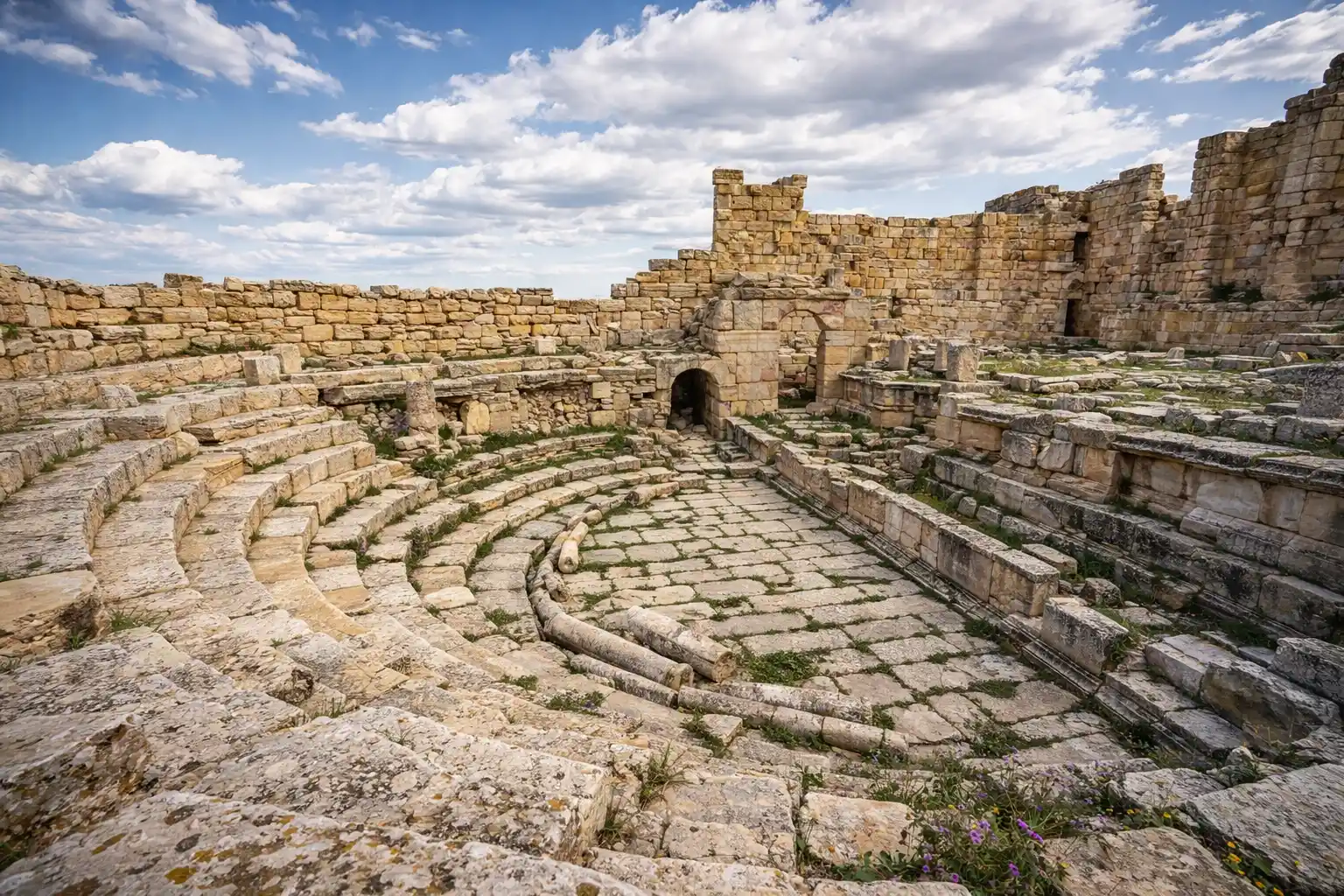
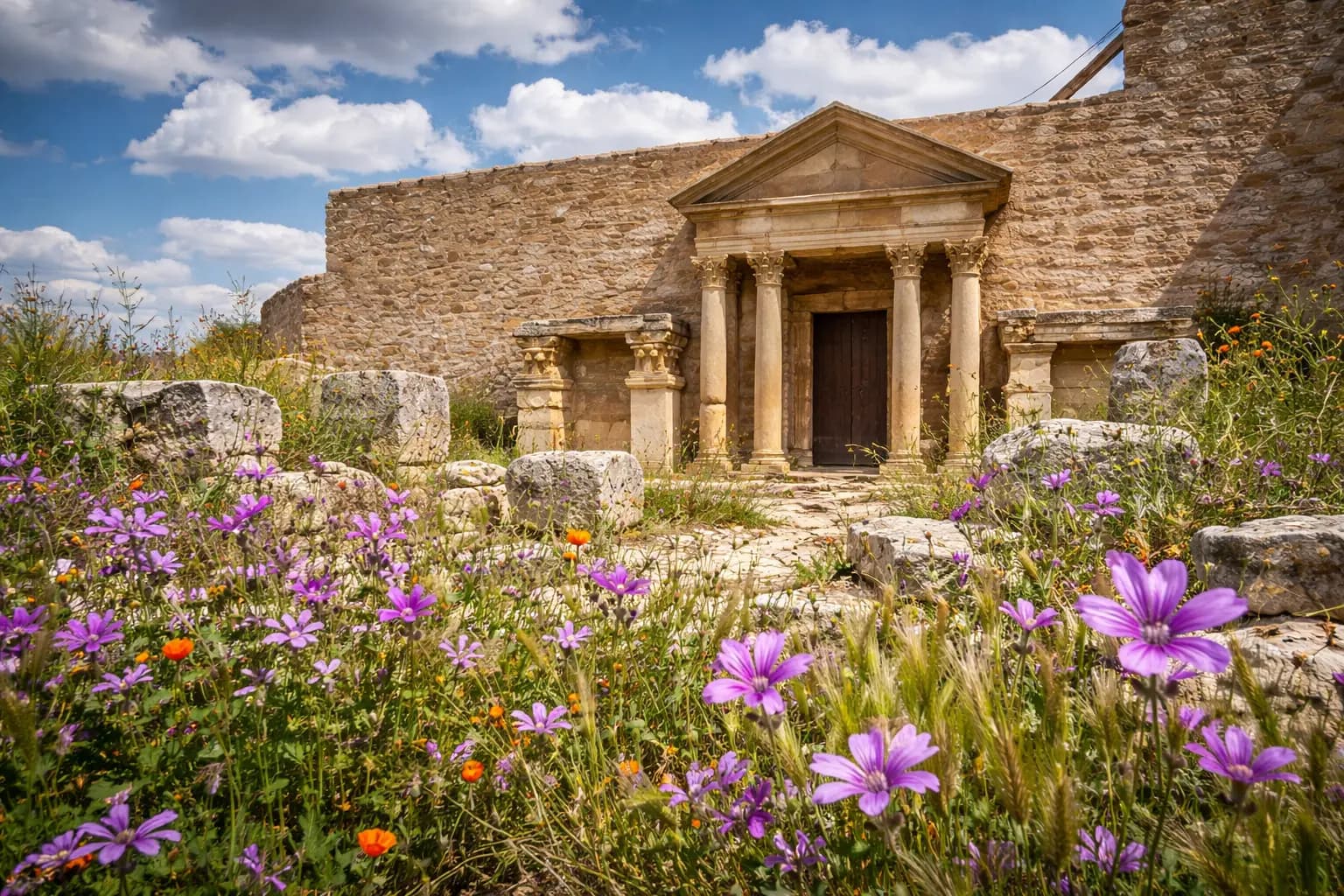
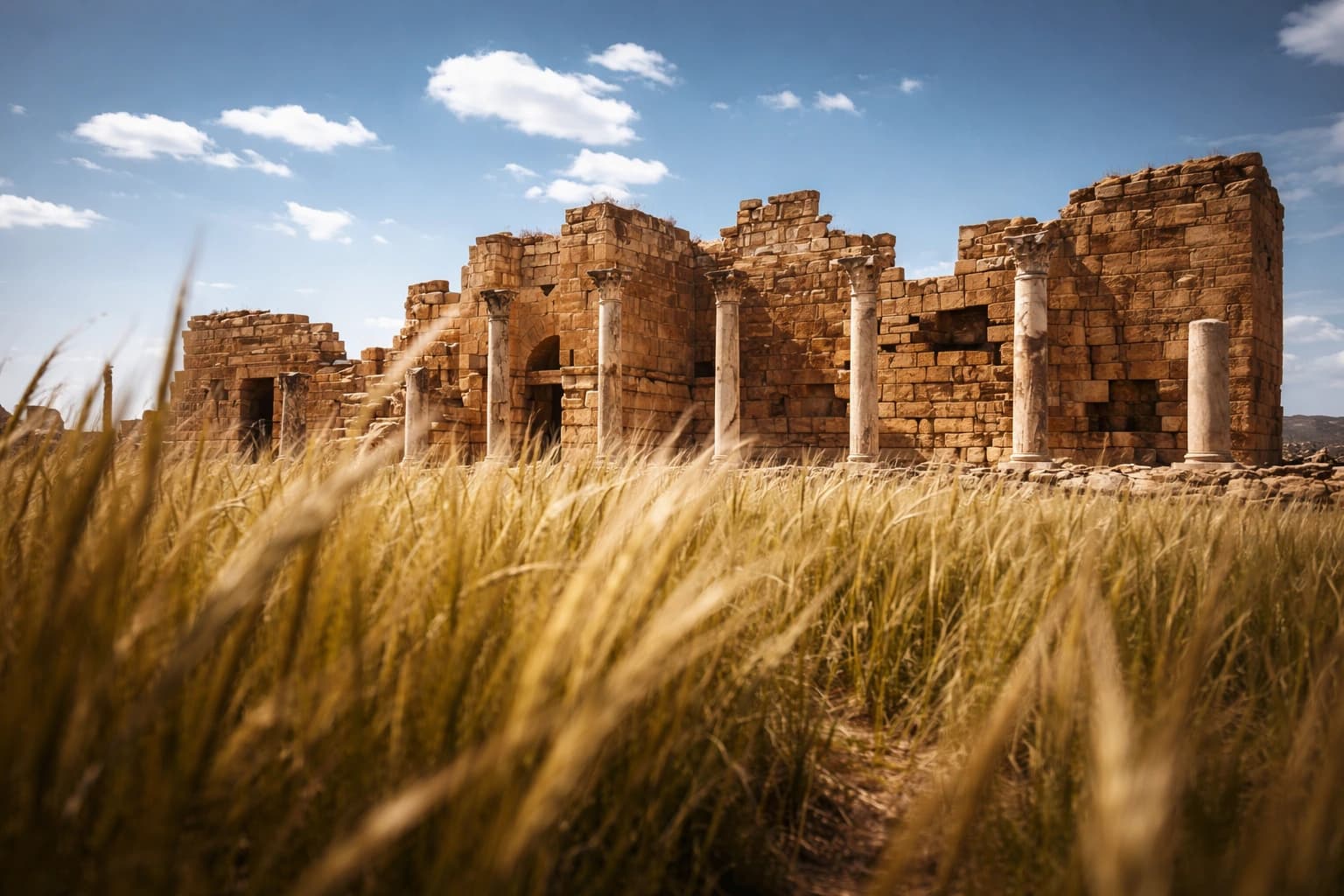
The ruins of Madauros are among the most significant and least-visited Roman sites in Algeria. Only a fraction of the city has been excavated, yet what is visible is remarkable:
- ›A colonnaded forum at the civic heart of the city
- ›A theatre, partially overlaid by a 6th-century Byzantine fortification — making the site a rare layered record of Roman and late-antique history
- ›Roman baths (thermae)
- ›Christian basilicas from the late Roman and Byzantine periods
- ›A mausoleum
- ›Inscriptions and sculptural fragments
- ›A paved Roman road and ancient gate
The site is experienced as an open-air archaeological landscape — quiet, largely unrestored, and genuinely atmospheric. There is no large on-site museum; artefacts are held in regional collections. What Madauros offers is something rarer: the ruins largely as time left them, in a highland setting of striking natural beauty.
Planning Your Visit
Madauros lies approximately 24 kilometres south of Souk Ahras, in an elevated highland landscape close to the Tunisian border. The drive takes roughly 30–40 minutes on regional roads through rolling agricultural country.
The best seasons are spring (March–May) and autumn (September–November), when the highland climate is mild and the light on the ruins is exceptional. Summer brings heat; winter can be cold at altitude.
Expect a quiet, unspoiled site with limited visitor infrastructure — no souvenir shops, no queues. Bring water, wear comfortable shoes for uneven terrain, and allow 2–3 hours to walk the site properly. The experience is scholarly and contemplative rather than commercial — exactly right for the heritage traveller who wants to see Roman Algeria as it actually is.
Gallery
Continue the Journey
Explore the full Via Augustina heritage route across northeastern Algeria.