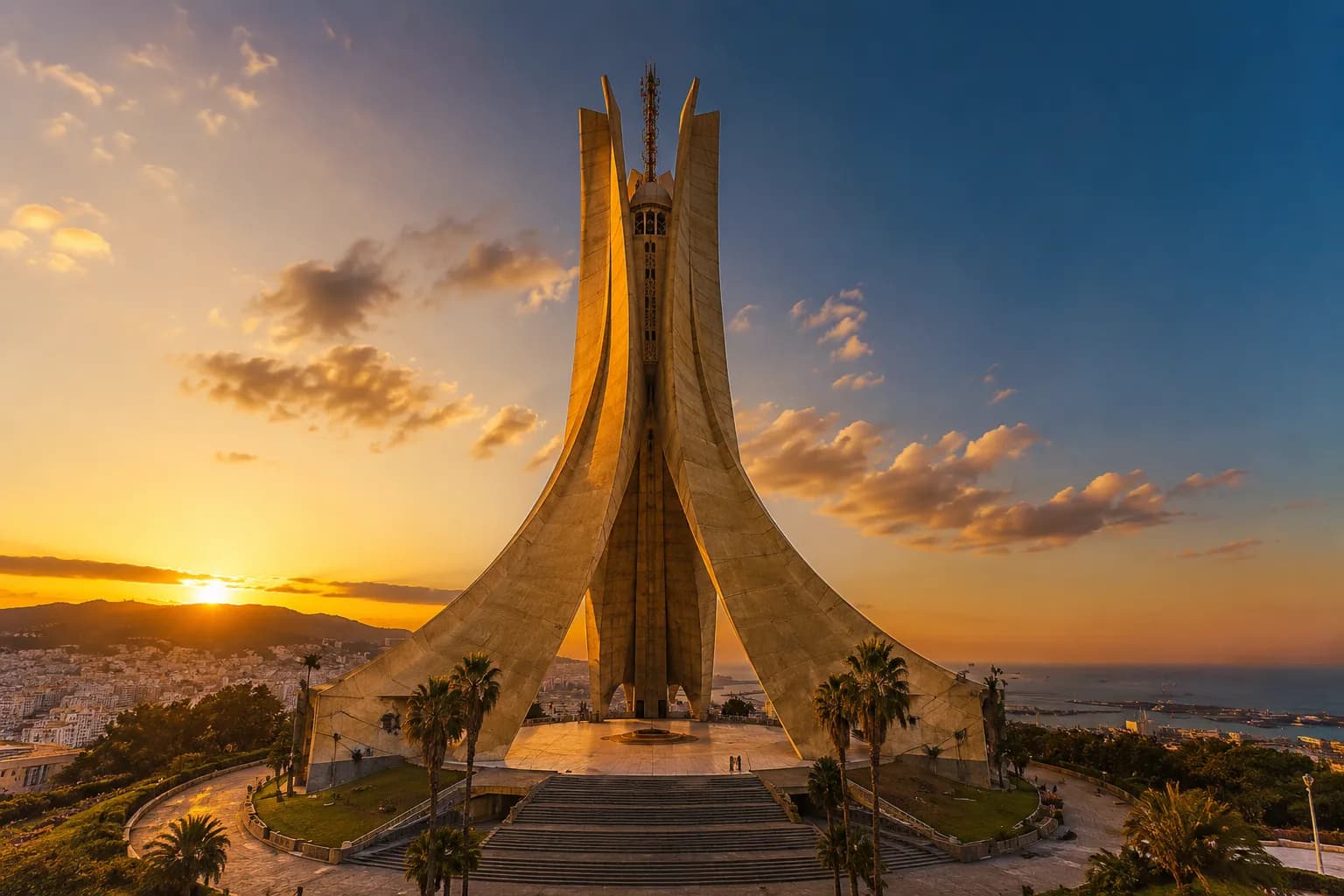
Algeria is one of the most misunderstood destinations on earth. Travellers who go come back changed — by the ruins, the food, the people, and the sheer scale of the country. Here is everything you need to know before you go.
There is a moment that happens to almost every first-time visitor to Algeria. It comes somewhere between the first bite of a proper couscous, the first sight of a Roman theatre with no one else in it, and the first conversation with a local who insists on inviting you for tea — and the thought arrives, unbidden: why has no one told me about this place?
Algeria is Africa's largest country. It has the Mediterranean's most spectacular Roman ruins, the world's largest Sahara territory, a coastline that rivals anything in southern Europe, mountain forests that turn green in spring, and a food culture that has never been diluted for foreign palates. It also has some of the warmest, most genuine hospitality you will find anywhere on earth.
And almost no one goes there.
That is changing — fast. And 2026 may be the last year you can still say you discovered it early.
Algeria is Having a Moment
The numbers tell the story. Algeria welcomed approximately 3.5 million tourists in 2024, up sharply from recent years, with a government target of 4 million by end of 2025 and an ambitious 12 million by 2030. That trajectory is not wishful thinking — it is being driven by something real: word is getting out.
Travel creators have found Algeria and they cannot stop talking about it. In January 2026, iShowSpeed (Darren Watkins Jr.) — one of the world's biggest streamers with tens of millions of followers — included Algeria in his "Speed Does Africa" tour, introducing the country to an audience that had never considered it. YouTube channels like Jason Billam Travel and The Bearded Backpacker documented the country in 2024–2025, while local creators like @OussamaTraveL, Zaza Filmmaker, and Algeria Tours 16 have been building a growing international audience around Algerian culture and landscape.
The framing is consistent across all of them: Algeria is a giant with a thousand faces — Sahara, Roman ruins, Mediterranean coast, Kabylie mountains, ancient medinas, extraordinary food — that the world is only now beginning to discover. Specialized expedition companies like MZUNGU Expeditions are now organizing dedicated cultural immersion tours for 2026, a sign that organized heritage tourism infrastructure is catching up with the growing interest.
The visitors going now are the early adopters — independent travelers, heritage enthusiasts, Catholic pilgrims following the Augustine route, and diaspora Algerians returning with foreign-born children. They share one thing in common: they come back wanting to return.
The Food, The People, The Landscape
Before we talk logistics, let's talk about why Algeria is worth the effort.
The food is extraordinary and almost completely unknown outside the country. Algerian cuisine draws on Berber, Arab, Ottoman, and French influences in a combination that produces dishes of real depth and complexity — slow-cooked tagines, hand-rolled couscous, stuffed vegetables, freshly baked flatbreads, pastries soaked in honey and orange blossom. In Algerian homes and local restaurants, you eat like a guest of the family. There are no tourist menus, no watered-down versions for foreign tastes. What locals eat is what you eat.
The people are the country's most powerful draw. Algerian hospitality is not a tourism industry construct — it is a cultural reality. Visitors consistently report being invited for tea by strangers, helped without being asked, and made to feel genuinely welcome in a way that has become rare in destinations that have been processing tourists for decades. In Souk Ahras, Annaba, and the smaller towns of the northeast, that welcome is especially warm.
The landscape ranges from the Mediterranean coast through cedar forests and mountain ranges to the Sahara — the largest on earth, and entirely Algerian in its most dramatic stretches. In the northeast alone, the rolling highlands around Souk Ahras, the Medjerda peaks, and the Burgas lakes offer natural beauty that few visitors have ever photographed.
The Roman Ruins — Better Than You Can Imagine
Algeria's Roman heritage is extraordinary. Timgad, Djemila, and Tipaza are UNESCO World Heritage Sites that regularly leave visitors speechless — and unlike comparable sites in Tunisia or Morocco, you may have them largely to yourself.
For visitors following the Augustine heritage route in the northeast, the ruins at Madauros (M'daourouch) and Thubursicum Numidarum (Khemissa) are among the best-preserved and least-visited Roman sites in the entire Mediterranean world. No entrance queues. No selfie crowds. No souvenir stalls blocking the view. Just ancient stone, open highland sky, and silence.
Algeria offers what Tunisia's Roman sites have largely lost and Morocco's never had: the ancient world in genuine solitude.
The Pope's Visit — A New Chapter for Religious Tourism
In April 2026, Pope Leo XIV visited Annaba — the first papal visit to Algeria in history. He came to the Basilica of Saint Augustine, overlooking the ancient city of Hippo Regius, where Augustine served as bishop for 34 years and wrote works that shaped Western civilization.
The visit placed Algeria's Christian heritage on the international radar in a way no tourism campaign could have achieved. Pilgrimage groups from Italy, France, Spain, and Latin America are now actively planning travel to Annaba and the Augustine route. For religious heritage tourism, 2026 is a landmark year.
What the Safety Advisories Actually Say
The honest picture on safety: northeastern Algeria is considerably safer than its reputation suggests. The UK, US, and French travel advisories maintain caution for Algeria, but read them carefully — the high-risk warnings are focused on specific zones: border areas near Libya, Mali, Mauritania and Niger, and deep Sahara routes without organized guides.
Souk Ahras, Annaba, Guelma, Constantine, and Tébessa are outside these restricted zones. The US State Department's Level 2 rating for Algeria is the same rating applied to France, Germany, and Belgium — it means exercise normal awareness, not avoid the country.
Travelers who have visited the northeast consistently report the same thing: visible security, low harassment, genuine calm, and a warmth from locals that makes the journey feel safe and welcoming. The danger narrative is decades out of date.
The Sahara — Scale That Changes You
Algeria contains the largest Saharan territory of any country on earth — bigger than the entire continental United States. For travelers drawn to silence, scale, and landscape that genuinely overwhelms the senses, the Algerian Sahara has no equal.
In 2025, foreign arrivals to Algerian Sahara destinations reached 65,000 — a steep climb from near-zero just years earlier. For visitors to the northeast, a Sahara extension to Tamanrasset or Djanet turns an Augustine pilgrimage into one of the most remarkable journeys available to any traveler anywhere.
The Visa — Worth the Effort
Getting an Algerian visa requires planning. For most Europeans and for Americans and Canadians, a tourist visa is required. There is no universal e-visa system yet, though Algeria announced digital reforms in 2025.
What gives you the best chance of approval:
- A confirmed hotel booking or host invitation
- A clear, simple itinerary
- Travel insurance
- Passport valid at least 6 months
- Applying 4–6 weeks in advance
The process is bureaucratic but manageable — and entirely worth it. The investment in paperwork pays off the moment you arrive. For the Augustine route specifically, a standard tourist visa covers Souk Ahras, Annaba, and Guelma without any additional permits.
Exceptional Value
Algeria is outstanding value. Accommodation, meals, local guides, and transport consistently come in below comparable North African destinations. A week in northeastern Algeria — covering the Augustine route and Roman sites — costs a fraction of a similar heritage trip in Tunisia or Jordan.
The Window Is Open — But It Won't Stay That Way
The travelers going to Algeria now will have stories that no one else has. The ruins to themselves. The welcome before it gets worn thin by crowds. The food before it gets adapted for foreign palates. The Sahara before the camps fill up.
Algeria is in the window Morocco was in thirty years ago. That window closes. The question is whether you are the kind of traveler who goes early — or the kind who arrives later and wishes they had.
For heritage travelers, pilgrims following Augustine's footsteps, and anyone who wants the ancient world without the modern crowd — the time is now.
Ready to take the first step? Explore the Augustine heritage route →